For organizations running Oracle Database Standard Edition, disaster recovery has traditionally involved a fairly well-understood set of compromises.
Oracle Standard Edition provides a highly capable database platform, but it does not include Oracle Data Guard. As a result, organizations that need a remote standby database typically need to consider Oracle Standard Edition HA and disaster recovery options, including backups, scripting or third-party replication solutions.
These approaches can provide very effective disaster recovery, and for many environments a Recovery Point Objective (RPO) measured in minutes is perfectly acceptable.
But what happens when it isn’t?
Until recently, achieving a recovery point measured in seconds or less on Oracle Standard Edition was considerably more difficult. Organizations with more demanding RPO requirements often found themselves considering Oracle Enterprise Edition and Data Guard, even when the application itself did not otherwise require Enterprise Edition functionality.
That has now changed.
Dbvisit has introduced their Zero Data Loss (ZDL) feature for StandbyMP, bringing sub-second RPO to suitable Oracle Standard Edition environments without requiring a move to Enterprise Edition. But what happens when it isn’t?
Why does the recovery point matter?
Two metrics sit at the heart of disaster recovery:
Recovery Time Objective (RTO) – how quickly the system needs to be available again.
Recovery Point Objective (RPO) – how much recent data the organization can afford to lose.
A standby may be healthy and ready to fail over, but that does not necessarily mean it contains every recent transaction from the primary.
For some systems, a few minutes of missing activity may be manageable. For others, those minutes could contain orders, payments, stock movements, bookings or other transactions that then need to be identified and reconstructed.
So the important question is: If the primary database failed right now, what point in time could you actually recover to? Where does the traditional RPO gap come from?
Physical standby solutions for Oracle Standard Edition have traditionally relied heavily on archive logs. Redo is generated on the primary database and written to the online redo logs. Once those logs are archived, they can be transferred to the standby and applied there.
It is a reliable and well understood process. The limitation is simply timing.
If replication has to wait for the current redo log to become an archive log before it can be transferred, there is inevitably a window between a transaction being committed on the primary and that transaction reaching the standby.
Depending on workload and configuration, that gap can be several minutes. This means a standby can be healthy and functioning exactly as designed, while still being behind the latest committed transactions on the primary.
What changes with StandbyMP Zero Data Loss?
ZDL adds a second replication mechanism to the existing StandbyMP architecture. But, importantly, it does not replace archive-log replication.
Archive logs continue to be transferred and applied as normal. Alongside this, ZDL continuously monitors the primary database’s online redo and streams changes to the standby as they are generated. Instead of waiting for the current archive log to complete, the latest redo is already being protected.
If the standby needs to be activated, this additional redo can be used during recovery to close the gap beyond the last completed archive log. In suitable environments, this can reduce potential data-loss exposure from minutes to less than a second.
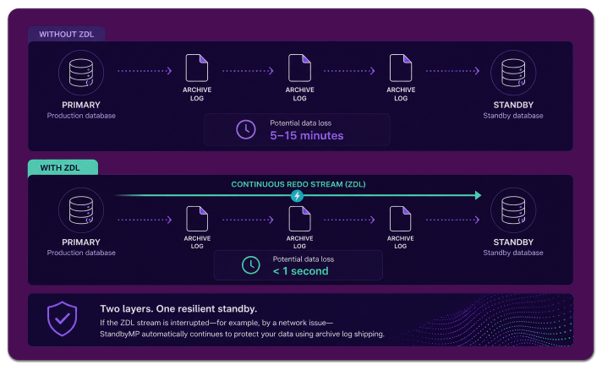
Two complementary replication paths
1. Archive-log replication – Provides the proven physical standby replication foundation.
2. Continuous redo streaming – Protects the changes occurring between completed archive logs.
For existing StandbyMP users, that is an important distinction. ZDL adds another layer of protection without requiring customers to discard the DR architecture and processes they already know.
What does “Zero Data Loss” mean in practice?
The terminology needs some context. During planned operations, StandbyMP’s Graceful Switchover functionality can support a transition without data loss.
During an unexpected infrastructure or database failure, ZDL is designed to provide a sub-second RPO in suitable environments.
As with asynchronous replication, a very small amount of redo may still be in memory, being generated or travelling across the network at the instant of an unexpected failure.
The actual result also depends on the environment. Network latency and bandwidth, storage performance, workload and redo generation all play a role. However, for most organizations, achieving a sub-second RPO is realistic. For organizations with extremely demanding recovery objectives, ZDL should therefore be assessed against the characteristics of the real production environment.
Does every Oracle Standard Edition database need sub-second RPO?
No — and nor should that be the objective.
Disaster recovery should be designed around what the application and business actually require. If losing five or ten minutes of activity would have little impact and the data could easily be recreated, an existing archive-log-based standby may already provide entirely adequate protection. However, other factors beyond simply the data, such as the time and resources required to restore a database may mean that it’s still a useful solution.
The conversation changes when those minutes contain data that is difficult, expensive or impossible to reconstruct.
A more useful way to assess the requirement is to ask:
– What does our current recovery-point window contain?
– Could we identify and recreate that data?
– What would reconciliation involve?
– What would the operational or financial impact be?
– Are there regulatory or contractual requirements around data loss?
Five minutes may be insignificant for one workload and a serious incident for another.
The right RPO is determined by the value and recoverability of the data, not simply by the database edition.
Does this change the Standard Edition vs Enterprise Edition decision?
Well, potentially.
ZDL does not remove the need for Oracle Enterprise Edition. Some workloads genuinely require Enterprise Edition for scale, performance, security, Oracle RAC clustering or other specific functionality.
What has changed is that disaster recovery alone may no longer need to be the reason an organization moves to Enterprise Edition.
If Oracle Standard Edition already meets the other technical requirements of the application, StandbyMP ZDL provides another route to a very low RPO without moving to Enterprise Edition purely to gain access to Data Guard.
For some organizations, that could materially change both the technical architecture and the licensing economics of the environment.
Is your current Oracle DR strategy still right for you?
An Oracle Standard Edition DR architecture designed several years ago may still be working perfectly well. However, whether your database is hosted on-premises, in the cloud or through a managed Oracle database hosting environment, both the technology available and the business requirements around that database may have changed.
That makes this a good time to revisit three questions:
1. What RPO does the business actually require?
2. What recovery point is the current environment delivering?
3. If there is a gap between the two, what is the most appropriate way to close it?
Vinters is an Oracle and Dbvisit partner and provides Oracle consultancy and management for existing Oracle environments. We can assess RTO and RPO requirements and determine whether StandbyMP Zero Data Loss is appropriate for the workload.
Find out if ZDL is right for your Oracle environment.
Could Your Oracle Environment Benefit from a Sub-Second RPO?
Already running Oracle Standard Edition or Dbvisit StandbyMP?
Vinters can review your current disaster recovery environment and help you understand your existing recovery point exposure, whether a sub-second RPO would provide meaningful value, and whether StandbyMP Zero Data Loss is appropriate for your workload.

